
RMS Lusitania
RMS Lusitania was a British ocean liner designed by Leonard Peskett[4] and built by John Brown and Company of Clydebank, Scotland. The ship entered passenger service with the Cunard Line on 26 August 1907. The ship was named after the ancient Roman province of Lusitania, which is part of present day Portugal. During the First World War, as Germany waged submarine warfare against Britain, the ship was identified and torpedoed by the German U-boat U-20 on 7 May 1915 and sank in eighteen minutes. The vessel went down eleven miles (18 km) off the Old Head of Kinsale,[5] Ireland, killing 1,198 of the 1,959 people aboard, leaving 761 survivors. The sinking turned public opinion in many countries against Germany, contributed to theAmerican entry into World War I and became an iconic symbol in military recruiting campaigns of why the war was being fought.[6]
Lusitania was constructed as part of the competition between the Cunard Line and other shipping lines, principally from Germany, for the trans-Atlantic passenger trade. Whichever company had the fastest and most luxurious ships had a commercial advantage: Lusitania and her sister Mauretania together provided a regular express service between Britain and the United States until the intervention of the First World War. The two ships both held the Blue Riband speed record for a transatlantic crossing at different times in their careers. Mauretania was generally the slightly faster of the two and continued to hold the record after the war until 1929.
The Cunard board had decided to use Parsons' turbine propulsion, which accounted for their 22-year retention of the speed record with her running mate RMS Mauretania, the turbines produced less onboard noise and vibration and more horsepower compared to expansion engines used in earlier vessels. The ships were the largest ever built at the time they were constructed, and had 50% greater passenger space than their nearest rivals, allowing unprecedented luxury for all three passenger classes.
The Lusitania was designed so that she might readily be converted to an auxiliary cruiser in times of war as part of an agreement with the British government who provided a loan of £2.6 million to finance her and Mauretania's construction. The ships attracted an ongoing operating subsidy and also held a valuable mail contract. In the event, the ships proved to be impractical armed cruisers (the liners all had very high fuel consumption and were found to be too expensive for the Admiralty to operate). Lusitania and other express liners were released from the Royal Navyshortly after the commencement of the war with instructions to resume passenger services, while Mauretania performed service as a troop ship. Cunard expressed a desire to lay up the ship for the duration of the war, but under the terms of the subsidy contract they were required to make all their ships available for government use and to carry government cargoes.
Lusitania had the misfortune to fall victim to torpedo attack relatively early in the First World War, before tactics for evading submarines were properly implemented or understood. The contemporary investigations both in the UK and US into the precise causes of the ship's loss were obstructed by the needs of wartime secrecy and a propaganda campaign to ensure all blame fell upon Germany. Argument over whether the ship was a legitimate military target raged back and forth throughout the war as both sides made misleading claims about the ship. At the time she was sunk she was carrying a large quantity of rifle ammunition and other supplies necessary for a war economy, as well as civilian passengers. Several attempts have been made over the years since the sinking to dive to the wreck seeking information about precisely how the ship sank, and argument continues to the current day.
Lusitania and her sister ship Mauretania were commissioned by Cunard, responding to increasing competition from rival transatlantic passenger companies, particularly the German Norddeutscher Lloyd (NDL) and Hamburg America Line (HAPAG). They had larger, faster, modern, more luxurious ships than Cunard and were better placed, starting from German ports, to capture the lucrative trade in emigrants leaving Europe for America. In 1897 the NDL liner Kaiser Wilhelm der Grossecaptured the Blue Riband from Cunard's Campania, before the prize was taken in 1900 by the HAPAG ship Deutschland. NDL soon wrested the prize back in 1903 with the new Kaiser Wilhelm II and Kronprinz Wilhelm. Cunard saw their business steadily declining as a result of the so called Kaiser class ocean liners.
The American millionaire businessman J. P. Morgan had decided to invest in trans-atlantic shipping by creating a new company International Mercantile Marine (IMM), and in 1901 had purchased the British freight shipper Frederick Leyland & Co and a controlling interest in the passenger White Star Line. In 1902 a 'Community of Interest' was agreed between IMM, NDL and HAPAG to fix prices and divide between them the transatlantic trade. The partners also acquired a 51% stake in the Dutch Holland America Line. Offers were made to purchase Cunard, which with French CGT were now their principle rivals. Cunard declined the offer, but lacked the financial resources to respond with new ships. The chairman of Cunard, Lord Inverclyde approached the British government for assistance. Faced with the impending collapse of the British liner fleet and consequent loss of national prestige, as well as the reserve of shipping for war purposes which it represented, they agreed to help. By an agreement signed in June 1903, Cunard was given a loan of £2.6 million to finance two ships, repayable over 20 years at a favourable interest rate of 2.75%. The ships would receive an annual operating subsidy of £75,000 each plus a mail contract worth £68,000. In return the ships would be built to admiralty specifications so that they could be used as auxiliary cruisers in wartime.
Design

Cunard established a committee to decide the design for the new ships. James Bain, Cunard's Marine Superintendent was the chairman, while other members included Rear Admiral H J Oram, who had been involved in designs for turbine powered ships for the navy, and Charles Parsons, whose company Parsons Marine was now producing revolutionary turbine engines. Parsons maintained that he could design engines capable of maintaining a speed of 25 knots, which would require 68,000 horse power. The largest turbine sets built thus far had been of 23,000 bhp for theDreadnought class battleships, and 41,000 bhp for Invincible class battlecruisers, which meant the engines would be of a new untested design. Turbines offered the advantages of less vibration in operation, greater reliability at high speeds and better fuel consumption. It was agreed that a trial would be made by fitting turbines to Carmania which was already under construction. The result was a ship 1.5 knots faster than her conventionally powered sister Caronia with the expected improvements in passenger comfort and operating economy.[9]
Lusitania was designed by Cunard's naval architect, Leonard Peskett. Peskett had built a large model of the proposed ship in 1902 showing a three funnel design. A fourth funnel was implemented into the design in 1904 as it was necessary to vent the exhaust from additional boilers fitted after steam turbines had been settled on as the powerplant. The original plan called for three propellers, but this was altered to four because it was felt the necessary power could not be transmitted through just three. Four turbines would drive four separate propellers with additional reversing turbines connected to the two inner shafts only. To improve efficiency, the two propellers either side nearest the rudder rotated inwards, while the outer propellers rotated outwards. The outer turbines operated at high pressure, with the exhaust steam then passing to the inner low pressure turbines. The propellers were driven directly by the turbines since sufficiently robust gearboxes were not available until developed by Parsons in 1916. Instead turbines had to be designed to run much slower than their optimum efficient speeds. The efficiency of the installed turbines was less at low speeds than a conventional triple expansion piston steam engine, but significantly better when the engines were run at high speed, as was usually the case for an express liner. There were 23 double ended boilers and two single ended (fitting the forward space where the ship narrowed), operating at a maximum 195 psi and containing 192 individual furnaces.[10]

Work to refine the hull shape was conducted in the Admiralty experimental tank at Haslar, Portsmouth. As a result of experiments the beam of the ship was increased 10 feet (3.0 m) compared to the initial design to improve stability. The hull immediately in front of the rudder and the balanced rudder itself followed naval design practice to improve rapid turning. The Admiralty contract required that all machinery be below the waterline, where it was considered to be better protected from gunfire. The rear third of the ship below water was used for the turbines, steering motors and four steam turbine driven 375Kw generators. The central half contained four boiler rooms, with the remaining space at the front of the ship reserved for cargo and other storage. Coal bunkers were placed along the length of the ship sandwiched between the hull and the boiler rooms, with a large transverse bunker immediately in front of the most forward, number 1 boiler room. Apart from convenience ready for use, the coal was considered to provide added protection for the central spaces against attack. At the very front were the chain lockers for the huge anchor chains and ballast tanks to adjust the ships trim. The hull space was divided into twelve watertight compartments, any two of which could be flooded without the ship sinking, connected by 35 hydraulically operated watertight doors. A critical difficulty with the watertight compartment design was that sliding doors to the coalbunkers needed to be open to feed coal all the time the ship was operating and closing these in emergency conditions could be problematic. The ship had a double bottom, with the space between divided into separate watertight cells. The ship's exceptional height was due to the six decks of passenger accommodation above the waterline, compared to the customary four decks in existing liners.[11]
High tensile steel was used for the ship's plating rather than the conventional mild steel. This allowed a reduction in plate thickness, reducing weight but still providing 26% greater strength than otherwise. Plates were held together by triple rows of rivets. The ship was heated and cooled throughout by a thermo-tank ventilation system, which used steam driven heat exchangers to warm air to a steady 65 °F (18.3 °C) while steam was injected into the airflow to maintain steady humidity. Forty-nine separate units driven by electric fans supplied seven complete air changes per hour throughout the ship in an interconnected system so that units could be switched out for maintenance. A separate system of exhaust fans removed air from galleys and bathrooms. As built, the ship conformed fully withBoard of Trade safety regulations, which required sixteen lifeboats, with a capacity of approximately 1000 people.[12]
Lusitania was briefly the largest ship ever built at the time of her completion (due to the slightly larger Mauretania, entering service shortly after.). She was 70 feet (21 m) longer, two knots faster, and 10,000 tons larger than the most modern German liner, Kronprinzessin Cecilie. Passenger accommodation was 50% larger than any of her competitors providing for 552 saloon class, 460 cabin class and 1,186 in third class. Her crew comprised 69 on deck, 369 operating engines and boilers and 389 to attend to passengers. She had wireless telegraph, electric light, electrical lifts and sumptuous interiors.[13]
[edit]Interiors

At the time of their introduction both Lusitania and Mauretania possessed the most luxurious interiors afloat. The Scottish architect James Millar was chosen to design Lusitania's interiors, while Harold Peto was chosen to design Mauretania. Millar chose to use plasterwork to create interiors whereas Peto made extensive use of wooden panelling, with the result that the overall impression given by Lusitania was brighter than Mauretania. Lusitania's designs proved the more popular.
In common with all major liners of the period, Lusitania’s interiors were decorated with a mélange of historical styles. The first class dining saloon was the grandest of the ship’s public rooms; arranged over two decks with an open circular well at its centre and crowned by an elaborate dome measuring 29 feet (8.8 m), decorated with frescos in the style of François Boucher, it was elegantly realized throughout in the neoclassical Louis XVI style.[14] The lower floor measuring 85 feet (26 m) could seat 323, with a further 147 on the 65 feet (20 m) upper floor. The walls were finished with white and gilt carved mahogany panels, with corinthian decorated columns where required to support the floor above. The one concession to seaborne life was that furniture was bolted to the floor, meaning passengers could not rearrange their seating for their personal convenience.
.jpg)

All other first class public rooms were situated on the boat deck and comprised a lounge, reading and writing room, smoking room and veranda café. The last was an innovation on a Cunard liner and, in warm weather, one side of the café could be opened up to give the impression of sitting outdoors. However this would have been a rarely used feature given the often inclement weather of the north Atlantic.[15] The first class lounge was decorated in Georgian style with inlaid mahogany panels surrounding a jade green carpet with a yellow floral pattern, measuring overall 68 feet (21 m). It had a barrel vaulted skylight rising to 20 feet (6.1 m) with stained glass windows each representing one month of the year. Each end of the lounge had a 14 feet (4.3 m) high green marble fireplace incorporating enamelled panels by Alexander Fisher. The design was linked overall with decorative plasterwork. The library walls were decorated with carved pillasters and mouldings marking out panels of grey and cream silk brocade. The carpet was rose, with Rose du Barry silk curtains and upholstery. The chairs and writing desks were mahogany, and the windows featured etched glass. The smoking room was Queen Anne style, with Italian walnut panelling and Italian red furnishings. The grand stairway linked all six decks of the passenger accommodation with wide hallways on each level and two lifts. First class cabins ranged from one shared room through various ensuite arrangements in a choice of decorative styles culminating in the two regal suites which each had two bedrooms, dining room, parlour and bathroom. The port suite decoration was modelled on the Petit Trianon.[16]
The second class public rooms were situated in a separate section of the superstructure aft of the first class passenger quarters. Design work was deputised to Robert Whyte, who was the architect employed by John Brown. Although smaller and plainer, the design of the dining room reflected that of first class, with just one floor of diners under a ceiling with a smaller dome and balcony. Walls were panelled and carved with decorated pillars, all in white. As with first class, the dining room was situated lower down in the ship on the saloon deck. The smoking and ladies rooms occupied the accommodation space of the second class promenade deck, with the lounge on the boat deck. Cunard had not previously provided a separate lounge for second class; the 42 feet (13 m) room had mahogany tables, chairs and setees set on a rose carpet. The smoking room was 52 feet (16 m) with mahogany panelling, white plasterwork ceiling and dome. One wall had a mosaic of a river scene in Brittany, while the sliding windows were blue tinted. There were no second class cabin suites, only standard shared cabins.[17]
Third class accommodation was plainer still, but, in comparison to other ships of the period, surprisingly comfortable and spacious. The 79 feet (24 m) dining room was at the bow of the ship on the saloon deck, finished in polished pine as were the other third class public rooms. Meals were eaten at long tables and there were two sittings for meals. A piano was provided for passenger use. A ladies lounge and smoking room were provided on the shelter deck immediately above the dining room. The roofed and partially enclosed space between the two had seating and provided some third class sheltered deck access in bad weather. Cabins were shared with a mixture of 2, 4 or 6 bunks and a wash basin, which was a significant improvement on previously typical dormitories.[18]
The Bromsgrove Guild had designed and constructed most of the trim on Lusitania.[19] Waring and Gillow tendered for the contract to furnish the whole ship, but failing to obtain this still supplied a number of the furnishings.
[edit]Construction and trials

Lusitania's keel was laid at John Brown on Clydebank as yard no. 367 on 16 June 1904, Lord Inverclyde hammering home the first rivet. Cunard nicknamed her 'the Scottish ship' in contrast to her sister whose contract went to Swan Hunter in England and who started building three months later. Final details of the two ships were left to designers at the two yards so that the ships differed in details of hull design and finished structure. The ships may most readily be distinguished in photographs through the flat topped ventilators used on Lusitania, whereas those on Mauretaniaused a more conventional rounded top. Mauretania was designed a little longer, wider, heavier and with an extra power stage fitted to the turbines.
The shipyard at John Brown had to be reorganised because of her size so that she could be launched diagonally across the widest available part of the river Clyde where it met a tributary, the ordinary width of the river being only 610 feet (190 m) compared to the 786-foot (240 m) long ship. The new slipway took up the space of two existing ones and was built on reinforcing piles driven deeply into the ground to ensure it could take the temporary concentrated weight of the whole ship as it slid into the water. Construction commenced at the bow working backwards, rather than the traditional approach of building both ends towards the middle. This was because designs for the stern and engine layout were not finalised when construction commenced. Railway tracks were laid alongside the ship and across deck plating to bring materials as required. The hull, completed to the level of the main deck but not fitted with equipment weighed approximately 16,000 tons.[20]
The ship's stockless bower anchors weighed 101⁄4 tons, attached to 125 ton, 330 fathom chains all manufactured by N. Hingley and Sons, Ltd. The steam capstans to raise them were constructed by Napier brothers Ltd, of Glasgow. The turbines were 25 feet (7.6 m) long with 12 ft (3.7 m) diameter rotors, the large diameter necessary because of the relatively low speeds at which they operated. The rotors were constructed on site, while the casings and shafting was constructed in John Brown's Atlas works in Sheffield. The machinery to drive the 56 ton rudder was constructed by Brown Brothers of Edinburgh. A main steering engine drove the rudder through worm gear and clutch operating on a toothed quadrant rack, with a reserve engine operating separately on the rack via a chain drive for emergency use. The 17 ft (5.2 m) three bladed propellers were fitted and then cased in wood to protect them during the launch.[21]
The ship was launched on 7 June 1906, eight weeks later than planned because of strikes and eight months after Lord Inverclyde's death. Princess Louise was invited to name the ship but could not attend, so the honour fell to Inverclyde's widow Mary.[22][23] The launch was attended by 600 invited guests and thousands of spectators.[24] 1000 tons of drag chains were attached to the hull by temporary rings to slow it once it entered the water. The wooden supporting structure was held back by cables so that once the ship entered the water it would slip forward out of its support. Six tugs were on hand to capture the hull and move it to the fitting out berth.[25]
Testing of the ship's engines took place in June 1907 prior to full trials scheduled for July. A preliminary cruise was arranged for 27 July with representatives of Cunard, the Admiralty, the Board of Trade, and John Brown aboard. The ship achieved speeds of 25.6 knots over a measured mile at Skelmorlie with turbines running at 194 revolutions per minute producing 76,000 shp. However, at high speeds the ship was found to suffer such vibration at the stern as to render the second class accommodation uninhabitable. VIP invited guests now came on board for a two day shakedown cruise during which the ship was tested under continuous running at speeds of 15, 18 and 21 knots but not her maximum speed. On 29 July the guests departed and three days of full trials commenced. The ship travelled four times between the Corsewall Light off Scotland to the Longship Light off Cornwall at 23 and 25 knots, between the Corsewall Light and Isle of Man, and Isle of Aran and Ailsa Craig. Over 300 miles (480 km) an average speed of 25.4 knots was achieved, comfortably greater than the 24 knots required under the admiralty contract. The ship could stop in 4 minutes in 3/4 of a mile starting from 23 knots at 166 rpm and then applying full reverse. She achieved a speed of 26 Knots over a measured mile loaded to a draught of 33 feet (10 m), and managed 26.5 knots over a 60-mile (97 km) course drawing 31.5 feet (9.6 m). At 180 revolutions a turning test was conducted and the ship performed a complete circle of diameter 1000 yards in 50 seconds. The rudder required 20 seconds to be turned hard to 35 degrees.[26][27]
The vibration was determined to be caused by interference between the wake of the outer propellers and inner and became worse when turning. At high speeds the vibration frequency resonated with the ships stern making the matter worse. The solution was to add internal stiffening to the stern of the ship but this necessitated gutting the second class areas and then rebuilding them. This required the addition of a number of pillars and arches to the decorative scheme. The ship was finally delivered to Cunard on 26 August although the problem of vibration was never entirely solved and further remedial work went on through her life.[28] In June 1908 the two outer propellers were replaced with others having a greater blade pitch which produced a modest improvement in performance. In April 1909 all four propellers were replaced with a four bladed design similar to those fitted on Mauretania with a six foot larger diameter weighing 23 tons. This change resulted in an approximate 1 knot increase in maximum speed and reduced vibration.
[edit]Comparison with the Olympic class
Lusitania and Mauretania were smaller than the White Star Line's Olympic-class vessels. Both vessels had been launched and had been in service for several years before the Olympic class ships were ready for the North Atlantic. Although significantly faster than the Olympic class would be, the speed of Cunard's vessels was not sufficient to allow the line to run a weekly two-ship transatlantic service from each side of the Atlantic. A third ship was needed for a weekly service, and in response to White Star's announced plan to build the three Olympic class ships, Cunard ordered a third ship: Aquitania. Like White Star Line's Olympic, Cunard's Aquitania had a lower service speed, but was a larger and more luxurious vessel.
The vessels of the Olympic class also differed from Cunard's Lusitania and Mauretania in the way in which they were compartmented below the waterline. The White Star vessels were divided by transverse watertight bulkheads. While Cunard's Lusitania also had transverse bulkheads, she additionally had longitudinal bulkheads running along the ship on each side, between the boiler and engine rooms and the coal bunkers on the outside of the vessel. The British commission that had investigated the Titanic disaster in 1912 heard testimony on the flooding of coal bunkers lying outside longitudinal bulkheads. Being of considerable length, when flooded, these could increase the ship's list and "make the lowering of the boats on the other side impracticable".[29] — and this was precisely what later happened with Lusitania. Furthermore the ship's stability was insufficient for the bulkhead arrangement used: Flooding of only three coal bunkers on one side could result in negative metacentric height.[30] On the other hand Titanic was given ample stability and sank with only a few degrees list, the design being such that there was very little risk of unequal flooding and possible capsize.[31]
[edit]Career

Lusitania, commanded by Commodore James Watt, moored at the Liverpool landing stage for hermaiden voyage at 16:30 on Saturday 7 September 1907 as the onetime Blue Riband holder RMS Lucania vacated the pier. At the time Lusitania was the largest ocean liner in service and would continue to be until the introduction of Mauretania in November that year. During her eight-year service, she made a total of 202 crossings on the Cunard Line's Liverpool-New York Route.
A crowd of 200,000 people gathered to see her departure at 21:00 for Queenstown, where she was to take on more passengers. She anchored again at Roches Point, off Queenstown, at 09:20 the following morning, where she was shortly joined by Lucania, which she had passed in the night, and 120 passengers were brought out to the ship by tender bringing her total of passengers to 2,320. At 12:10 on Sunday Lusitania was again under way and passing the Daunt Rock Lightship. In the first 24 hours she achieved 561 miles (903 km), with further daily totals of 575, 570, 593 and 493 miles (793 km) before arriving at Sandy Hook at 09:05 Friday 13 September, taking in total 5 days and 54 minutes, 30 minutes outside the record time held by Kaiser Wilhelm II of the North German Lloyd line. Fog had delayed the ship on two days, and her engines were not yet run in. In New York hundreds of thousands of people gathered on the bank of the River Hudson from Battery Park to pier 56. All New York's police had been called out to control the crowd. 100 horse drawn cabs had been queuing from the start of the day ready to take away passengers. During the week's stay the ship was made available for guided tours. At 15:00 on Saturday 21 September, the ship departed on the return journey, arriving Queenstown 04:00 27 September and Liverpool 12 hours later. The return journey was 5 days 4 hours and 19 minutes, again delayed by fog.[32]
On her second voyage in better weather, Lusitania arrived at Sandy Hook on 11 October 1907 in the Blue Riband record time of 4 days, 19 hours and 53 minutes. She had to wait for the tide to enter harbour where news had proceeded her and she was met by a fleet of small craft, whistles blaring. Lusitania averaged 23.99 knots (44.43 km/h) westbound and 23.61 knots (43.73 km/h) eastbound. In December 1907,Mauretania entered service and took the record for the fastest eastbound crossing. Lusitania made her fastest westbound crossing in 1909 after her propellers were changed, averaging 25.85 knots (47.87 km/h). She briefly recovered the record in July of that year, but Mauretaniarecaptured the Blue Riband the same month, retaining it until 1929, when it was taken by SS Bremen.[33]
- RMS Lusitania arriving in New York on 13 September 1907 on her maiden voyage
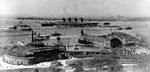


[edit]Hudson Fulton Celebration


Lusitania and other ships participated in the Hudson-Fulton Celebration in New York City from the end of September to early October 1909. This was in celebration of the 300th anniversary of Henry Hudson's trip up the river that bears his name and the 100th anniversary of Robert Fulton's steamboat, Clermont. The celebration also was a display of the different modes of transportation then in existence, Lusitaniarepresenting the newest advancement in steamship technology. A newer mode of travel was the aeroplane. Wilbur Wright had brought a Flyer toGovernors Island and proceeded to make demonstration flights before millions of New Yorkers who had never seen an aircraft. Some of Wright's trips were directly over Lusitania; several photographs of Lusitania from that week still exist.
[edit]War
When Lusitania was built, her construction and operating expenses were subsidised by the British government, with the proviso that she could be converted to an Armed Merchant Cruiser if need be. At the outbreak of the First World War, the British Admiralty considered her for requisition as an armed merchant cruiser, and she was put on the official list of AMCs. The Admiralty then cancelled their earlier decision and decided not to use her as an AMC after all; large liners such as Lusitania consumed enormous quantities of coal (910 tons/day, or 37.6 tons/hour) and became a serious drain on the Admiralty's fuel reserves, so express liners were deemed inappropriate for the role when smaller cruisers would do. They were also very distinctive; so smaller liners were used as transports instead. Lusitania remained on the official AMC list and was listed as an auxiliary cruiser in the 1914 edition of Jane's All the World's Fighting Ships, along with Mauretania.[34]
At the outbreak of hostilities, fears for the safety of Lusitania and other great liners ran high. During the ship’s first east-bound crossing after the war started, she was painted in a drab grey colour scheme in an attempt to mask her identity and make her more difficult to detect visually. When it turned out that the German Navy was kept in check by the Royal Navy, and their commerce threat almost entirely evaporated, it very soon seemed that the Atlantic was safe for ships like Lusitania, if the bookings justified the expense of keeping them in service.

Many of the large liners were laid up over the autumn and winter of 1914–1915, in part due to falling demand for passenger travel across the Atlantic, and in part to protect them from damage due to mines or other dangers. Among the most recognizable of these liners, some were eventually used as troop transports, while others became hospital ships. Lusitania remained in commercial service; although bookings aboard her were by no means strong during that autumn and winter, demand was strong enough to keep her in civilian service. Economizing measures were taken, however. One of these was the shutting down of her No. 4 boiler room to conserve coal and crew costs; this reduced her maximum speed from over 25 knots (46 km/h) to 21 knots (39 km/h). Even so, she was the fastest first-class passenger liner left in commercial service.
With apparent dangers evaporating, the ship’s disguised paint scheme was also dropped and she was returned to civilian colours. Her name was picked out in gilt, her funnels were repainted in their traditional Cunard livery, and her superstructure was painted white again. One alteration was the addition of a bronze/gold coloured band around the base of the superstructure just above the black paint.[35]
[edit]1915

By early 1915 a new threat began to materialize: submarines. At first they were used by the Germans only to attack naval vessels, and they achieved only occasional – but sometimes spectacular – successes. Then the U-boats began to attack merchant vessels at times, although almost always in accordance with the old cruiser rules. Desperate to gain an advantage on the Atlantic, the German government decided to step up their submarine campaign. On 4 February 1915 Germany declared the seas around the British Isles a war zone: from 18 February allied ships in the area would be sunk without warning. This was not wholly unrestricted submarine warfare since efforts would be taken to avoid sinking neutral ships.[36]

Lusitania was scheduled to arrive in Liverpool on 6 March 1915. The Admiralty issued her specific instructions on how to avoid submarines. Despite a severe shortage of destroyers, Admiral Henry Oliver ordered HMS Louis and Laverock to escort Lusitania, and took the further precaution of sending the Q ship Lyons to patrol Liverpool Bay.[37] The destroyer commander attempted to discover the whereabouts ofLusitania by telephoning Cunard, who refused to give out any information and referred him to the admiralty. At sea the ships contacted Lusitaniaby radio, but did not have the codes used to communicate with merchant ships. Captain Dow of Lusitania refused to give his own position except in code, and since he was in any case some distance from the positions they gave, continued to Liverpool unescorted.[38]
It seems that in response to this new submarine threat, some alterations were made to Lusitania and her operation. She was ordered not to fly any flags in the War Zone, a number of warnings and advices were sent to the ship’s commander in order to help him decide how to best protect his ship against the new threat, and it also seems that her funnels were most likely painted a dark grey to help make her less visible to enemy submarines. Clearly there was no hope of disguising her actual identity, since her profile was so well-known, and no attempt was made to paint out the ship’s name at the prow.[39]
Captain Dow, apparently suffering from stress from operating his ship in the War Zone, and after a significant “false flag” controversy, left the ship; Cunard later explained that he was "tired and really ill."[40]He was replaced with a new commander, Captain William Thomas Turner, who had previously commandedLusitania, Mauretania and Aquitania in the years before the war.
On 17 April 1915 Lusitania left Liverpool on her 201st transatlantic voyage, arriving in New York on 24 April. A group of German–Americans, hoping to avoid controversy if Lusitania were attacked by a U-boat, discussed their concerns with a representative of the German embassy. The embassy decided to warn passengers before her next crossing not to sail aboard Lusitania. The Imperial German embassy placed a warning advertisement in 50 American newspapers, including those in New York (see illustration).
[edit]Last voyage and sinking
[edit]Departure

Lusitania departed Pier 54 in New York on 1 May 1915. The German Embassy in Washington had issued this warning on 22 April.[41]
NOTICE!
TRAVELLERS intending to embark on the Atlantic voyage are reminded that a state of war exists between Germany and her allies and Great Britain and her allies; that the zone of war includes the waters adjacent to the British Isles; that, in accordance with formal notice given by the Imperial German Government, vessels flying the flag of Great Britain, or any of her allies, are liable to destruction in those waters and that travellers sailing in the war zone on the ships of Great Britain or her allies do so at their own risk.
IMPERIAL GERMAN EMBASSY
Washington, D.C. 22nd April 1915
This warning was printed adjacent to an advertisement for Lusitania's return voyage. The warning led to some agitation in the press and worried the ship's passengers and crew.
Captain William Thomas Turner, known as "Bowler Bill" for his favourite shoreside headgear, had returned to his old command of Lusitania. He was commodore of the Cunard Line and a highly experienced master mariner, and had relieved Daniel Dow, the ship's regular captain. Dow had been instructed by his chairman, Alfred Booth, to take some leave, due to the stress of captaining the ship in U-boat infested sea lanes and for his protestations that the ship should not become an armed merchant cruiser, making her a prime target for German forces.[42][citation needed]. Captain Turner tried to calm the passengers by explaining that the ship's speed made her safe from attack by submarine.[citation needed] However, Cunard shut down one of the ship's four boiler rooms to reduce costs on sparsely subscribed wartime voyages, reducing her top speed from 25.5 to around 22 knots.[43]
Lusitania steamed out of New York at noon on May 1, two hours behind schedule because of a last-minute transfer of forty-one passengers and crew from the recently requisitioned Cameronia.[44] Shortly after departure three German-speaking men were found on board hiding in a steward's pantry. Detective Inspector William Pierpoint of the Liverpool police, who was travelling in the guise of a first class passenger, interrogated them before locking them in the cells for further questioning when the ship reached Liverpool.[45] Also among the crew was an Englishman, Neal Leach, who had been working as a tutor in Germany before the war. Leach had been interned but later released by Germany. The German embassy in Washington was notified about Leach's arrival in America where he met known German agents. Leach and the three German stowaways went down with the ship, but they had probably been tasked with spying on the Lusitania and its cargo. Most probably, Pierpoint would already have been informed about Leach.[46]
[edit]Passengers
Lusitania carried 1,959 people on her last voyage, with 1,265 passengers and 694 crew aboard. Those aboard included a large number of illustrious and renowned people including:
- Theodate Pope Riddle, American architect and philanthropist (survived)
- Canadian businessman Sir Frederick Orr Lewis, 1st Baronet (survived)
- William R. G. Holt, son and heir of Canadian banker Sir Herbert Samuel Holt (survived)
- Montreal socialite Frances McIntosh Stephens, wife of politician George Washington Stephens (died)
- Mary Crowther Ryerson of Toronto, wife of George Sterling Ryerson, founder of the Canadian Red Cross (died)
- Lindon W. Bates, Jr., New York engineer, economist and political figure (died)
- British former MP David Alfred Thomas (survived)
- His daughter Margaret, Lady Mackworth, British suffragist (survived)
- Edwin W. Friend, professor of philosophy at Harvard University and co-founder of the American Society for Psychical Research (died, left a wife five months pregnant behind)
- Oxford professor and writer Ian Holbourn (survived)
- H. Montagu Allan's wife Marguerite (survived) and daughters Anna (died) and Gwendolyn (died)
- Actresses Rita Jolivet (survived), Josephine Brandell (survived) and Amelia Herbert (died)
- Belgian nurse Marie Depage (died), wife of surgeon Antoine Depage
- New York fashion designer Carrie Kennedy (died) and her sister, Kathryn Hickson (died)
- American building contractor and hotel proprietor Albert Bilicke (died)
- Renowned chemist Anne Justice Shymer, president of the United States Chemical Company (died)
- Playwright Charles Klein (died)
- American writer Justus Miles Forman (died)
- American theatre impresario Charles Frohman (died)
- American philosopher, writer and Roycroft founder Elbert Hubbard (died)
- His wife Alice Moore Hubbard, author and woman's rights activist (died)
- Wine merchant and philanthropist George Kessler (survived)
- American pianist Charles Knight (died) and sister, Elaine Knight (died)
- Renowned Irish art collector and founder of the Hugh Lane Municipal Gallery in Dublin Sir Hugh Lane (died)
- American socialite Beatrice Witherbee (survived), wife of Alfred S. Witherbee, president of the Mexican Petroleum Solid Fuel Company
- Her son Alfred Scott Witherbee, Jr. (died) and her mother, Mary Cummings Brown (died)
- American engineer and entrepreneur Frederick Stark Pearson (died) and his wife Mabel (died)
- Genealogist Lothrop Withington (died)
- Sportsman, millionaire, member of the Vanderbilt family, Alfred Gwynne Vanderbilt (died) — last seen fastening a life vest onto a woman holding a baby.
- Scenic designer Oliver P. Bernard (survived), whose sketches of the sinking were published in the Illustrated London News
- Politician and future United States Ambassador to Spain, Ogden H. Hammond of Louisville, Kentucky (survived) and his first wife, Mary Picton Stevens of Hoboken, New Jersey (died), a descendant of John Stevens and Robert Livingston Stevens (parents of former New Jersey Congresswoman Millicent Fenwick)
- Dr. Howard L. Fisher, brother of Walter L. Fisher, former United States Secretary of the Interior (survived)
- Herbert S. Stone, New York newspaper editor and publisher, creator of magazines The Chap Book and The House Beautiful, son ofMelville Elijah Stone (died)
- Rev. Dr. Basil W. Maturin, British theologist, author and rector of Saint Clement's Church in Philadelphia, Pennsylvania (died)
- Debutant Miss Phyllis Hutchinson, 20-year-old niece of businessman Robert A. Franks of West Orange, New Jersey, financial agent forAndrew Carnegie (died)
- Irish composer and conductor T. O'Brien Butler (died)
- Arthur Henry Adams, president of the United States Rubber Company (died)
- James A. Dunsmuir, of Toronto, Canadian soldier, younger son of James Dunsmuir (died)
- Charles T. Jeffery, automobile manufacturer who became head of the Thomas B. Jeffery Company after his father's death (survived)
- Paul Crompton, director of Booth Steamship Company Ltd. (died), and his wife Gladys (died), six children (died), and nanny (died)
- Elisabeth Antill Lassetter, wife of Major General Harry B. Lassetter and sister of Major General John M. Antill (survived)
- Josephine Eaton Burnside, daughter of Canadian department store founder Timothy Eaton (survived), and her daughter Iris Burnside (died)
- Albert L. Hopkins, president of Newport News Shipbuilding and Drydock Company (died)
- William Sterling Hodges, wife Sarah and two sons, William and Dean (all died)
- William Broderick Cloete, mining entrepreneur who was returning to London from Mexico. His body was not found.
- George Stevens, butcher of Princes Risborough, Buckinghamshire, England who had emigrated to the US a few years earlier but had decided to return to England (survived)
[edit]Submarine activity

As the liner steamed across the ocean, the British Admiralty had been tracking the movements ofU-20, commanded by Kapitänleutnant Walther Schwieger, through wireless intercepts and radio direction finding. The submarine left Borkum on 30 April, heading north west across the North Sea. On 2 May she had reached Peterhead and proceeded around the north of Scotland and Ireland, and then along the western and southern coasts of Ireland, to enter the Irish Sea from the south. Although the submarine's departure, destination and expected arrival time were known to Room 40in the admiralty, the activities of the decoding department were considered so secret that they were unknown even to the normal intelligence division which tracked enemy ships or to the trade division responsible for warning merchant vessels. Only the very highest officers in the admiralty saw the information and passed on warnings only when they felt it essential.[47]
On 27 March, Room 40 had intercepted a message which clearly demonstrated that the Germans had broken the code used to pass messages to British merchant ships. Cruisers protecting merchant ships were warned not to use the code to give directions to shipping because it could just as easily attract enemy submarines as steer ships away from them. Queenstown was not given this warning and continued to give directions in the compromised code, which was not changed until after Lusitania's sinking. At this time the Navy was significantly involved with operations leading up to the landings atGallipoli, and the intelligence department had been undertaking a program of misinformation to convince Germany to expect an attack on her northern coast. As part of this, ordinary cross-channel traffic to the Netherlands was halted from 19 April and false reports were leaked about troop ship movements from British west and south coast ports. This led to a demand from the German army for offensive action against the expected troop movements, and consequently, a surge in German submarine activity on the British west coast. The fleet was warned to expect additional submarines, but this warning was not passed on to those sections of the navy dealing with merchant vessels. The return of the battleship Orion from Devonport to Scotland was delayed until 4 May and she was given orders to stay 100 miles (160 km) from the Irish coast.[48]

On 5 May U-20 stopped a merchant schooner, the Earl of Lathom off the Old Head of Kinsale, examined her papers, then ordered her crew to leave before sinking the schooner with gunfire. On 6 May, U-20 fired a torpedo at Cayo Romano from Cuba, a British steamer flying a neutral flag, offFastnet Rock missing by a few feet.[49] The Royal Navy sent an uncoded warning to all ships at 10:30 pm on 5 May - "Submarines active off the south coast of Ireland" - and at midnight an addition was made to the regular nightly warnings, "submarine off Fastnet".[50] On 6 May U-20sank the 6,000 ton steamer Candidate. It then failed to get off a shot at the 16,000 ton linerArabic, because although she kept a straight course the liner was too fast, but then sank another 6,000 ton British cargo ship flying no flag, Centurion, all in the region of the Coningbeg light ship. The specific mention of a submarine was dropped from the midnight broadcast on 6–7 May as news of the new sinkings had not yet reached the navy at Queenstown, and it was correctly assumed that there was no longer a submarine at Fastnet.[51]
Captain Turner of Lusitania was given a warning message twice on the evening of 6 May, and took what he felt were prudent precautions. He closed watertight doors, posted double lookouts, ordered a black-out, and had the lifeboats swung out on their davits so that they could be launched quickly if necessary.[citation needed] That evening a Seamen's Charities fund concert took place throughout the ship and the captain was obliged to attend the event in the first class lounge.[52]
At about 11:00 on 7 May, the Admiralty radioed another warning to all ships, probably as a result of a request by Alfred Booth who was concerned about Lusitania: "U-boats active in southern part of Irish Channel. Last heard of twenty miles south of Coningbeg Light Vessel". Booth and all of Liverpool had received news of the sinkings, which the admiralty had known about by at least 3:00 that morning.[53] Turner adjusted his heading northeast, not knowing that this report related to events of the previous day and apparently thinking submarines would be more likely to keep to the open sea, so that Lusitania would be safer close to land.[54] At 13:00 another message was received, "Submarine five miles south of Cape Clear proceeding west when sighted at 10:00am". This report was entirely inaccurate as no submarine had been at that location, but gave the impression that at least one submarine had been safely passed.[55]
U-20 was low on fuel and had only three torpedoes left. On the morning of 7 May visibility was poor and Schwieger decided to head for home. He submerged at 11:00 after sighting a fishing boat which he believed might be a British patrol and shortly after was passed while still submerged by a ship at high speed. This was the cruiser Juno returning to Queenstown, travelling fast and zig-zagging having received warning of submarine activity off Queenstown at 07:45. The admiralty considered these old cruisers highly vulnerable to submarines and indeed Schwieger attempted to target the ship.[56][57]
[edit]Sinking
On the morning of 6 May, Lusitania was 750 miles (1,210 km) west of southern Ireland. By 05:00 on 7 May she reached a point 120 miles (190 km) west south west of Fastnet Rock (off the southern tip of Ireland), where she met the patrolling boarding vessel Partridge.[58] By 06:00, heavy fog had arrived and extra lookouts were posted. As the ship came closer to Ireland Captain Turner ordered depth soundings to be made and at 08:00 for speed to be reduced to eighteen knots, then to 15 knots and for the foghorn to be sounded. Some of the passengers were disturbed that the ship appeared to be advertising her presence. By 10:00 the fog began to lift, by noon it had been replaced by bright sunshine over a clear smooth sea and speed increased to 18 knots.[59]
U-20 surfaced again at 12:45 as visibility was now excellent. At 13:20 something was sighted and Schwieger was summoned to the conning-tower: at first it appeared to be several ships because of the number of funnels and masts, but this resolved into one large steamer appearing over the horizon. At 13:25 the submarine submerged to periscope depth of 11 metres and set a course to intercept the liner at her maximum submerged speed of 9 knots. When the ships had closed to 2 miles (3.2 km) Lusitania turned away, Schwieger feared he had lost his target, but she turned again, this time onto a near ideal course to bring her into position for an attack. At 700m range he ordered one gyroscopic torpedo to be fired, set to run at a depth of three metres, which was fired at 14:10.[60][61]
In Schwieger's own words, recorded in the log of U-20:
Torpedo hits starboard side right behind the bridge. An unusually heavy detonation takes place with a very strong explosive cloud. The explosion of the torpedo must have been followed by a second one [boiler or coal or powder?]... The ship stops immediately and heels over to starboard very quickly, immersing simultaneously at the bow... the name Lusitania becomes visible in golden letters.[62]
The U-20's torpedo officer, Raimund Weisbach, viewed the destruction through the vessel's periscope and felt the explosion was unusually severe. Within six minutes, Lusitania's forecastle began to submerge.
Leslie Morton, an eighteen-year-old lookout at the bow, spotted thin lines of foam racing toward the ship. He shouted "Torpedoes coming on the starboard side!" through a megaphone, thinking the bubbles came from two projectiles. The torpedo struck Lusitania under the bridge, sending a plume of debris, steel plating and water upward and knocking lifeboat number five off its davits. "It sounded like a million-ton hammer hitting a steam boiler a hundred feet high," one passenger said. A second, more powerful explosion followed, sending a geyser of water, coal, dust, and debris high above the deck. Schwieger's log entries attest that he only launched one torpedo. Some doubt the validity of this claim, contending that the German government subsequently altered the published fair copy of Schwieger's log,[63] but accounts from other U-20 crew members corroborate it. The entries were also consistent with intercepted radio reports sent to Germany by U-20 once she had returned to the North Sea, before any possibility of an official coverup.[64]


At 14:12 Captain Turner ordered Quartermaster Johnston stationed at the ship's wheel to steer 'hard-a-starboard' towards the Irish coast, which Johnston confirmed, but the ship could not be steadied on the course and rapidly ceased to respond to the wheel. Turner signalled for the engines to be reversed to halt the ship, but although the signal was received in the engine room, nothing could be done. Steam pressure had collapsed from 195 psi before the explosion, to 50 psi and falling afterwards.[65] Lusitania's wireless operator sent out an immediateSOS, which was acknowledged by a coastal wireless station. Shortly afterward he transmitted the ship's position, 10 miles (16 km) south of the Old Head of Kinsale.[66] At 14:14 electrical power failed, plunging the cavernous interior of the ship into darkness. Radio signals continued on emergency batteries, but electric lifts failed, trapping passengers and crew; bulkhead doors closed as a precaution before the attack could not be reopened to release trapped men.[67]
Captain Turner gave the order to abandon ship. Water had flooded the ship's starboard longitudinal compartments, causing a 15-degree list to starboard.
Lusitania's severe starboard list complicated the launch of her lifeboats. Ten minutes after the torpedoing, when she had slowed enough to start putting boats in the water the lifeboats on the starboard side swung out too far to step aboard safely.[68] While it was still possible to board the lifeboats on the port side, lowering them presented a different problem. As was typical for the period, the hull plates of Lusitaniawere riveted, and as the lifeboats were lowered they dragged on the inch high rivets, which threatened to seriously damage the boats before they landed in the water.

Many lifeboats overturned while loading or lowering, spilling passengers into the sea; others were overturned by the ship's motion when they hit the water. It has been claimed[69] that some boats, because of the negligence of some officers, crashed down onto the deck, crushing other passengers, and sliding down towards the bridge. This has been refuted in various articles and by passenger and crew testimony.[70] Crewmen would lose their grip on the falls—ropes used to lower the lifeboats—while trying to lower the boats into the ocean, and this caused the passengers from the boat to "spill into the sea like rag dolls."[cite this quote] Others would tip on launch as some panicking people jumped into the boat. Lusitania had 48 lifeboats, more than enough for all the crew and passengers, but only six were successfully lowered, all from the starboard side. Lifeboat 1 had overturned as it was being lowered, spilling its original occupants into the sea. However, it managed to right itself shortly afterwards and was later filled with people from in the water. Lifeboats 9 and 11 managed to reach the water safely with only a few handfuls of people, but both later picked up many swimmers. Lifeboats 13 and 15 also safely reached the water, each overloaded with around seventy people. Finally, Lifeboat 21 managed to reach the water safely and cleared the ship only moments before her final plunge. A few of her collapsible lifeboats washed off her decks as she sank and provided refuge for many of those in the water.
There was panic and disorder on the decks. Schwieger had been observing this through U-20's periscope, and by 14:25, he dropped theperiscope and headed out to sea.[71] Later in the war, Schwieger was killed in action when, as commander of U-88, he was chased byHMS Stonecrop, hit a British mine, and sank on 5 September 1917, north of Terschelling. There were no survivors from U-88's sinking.


Captain Turner remained on the bridge until the water rushed upward and destroyed the sliding door, washing him overboard into the sea. He took the ship's logbook and charts with him. He managed to escape the rapidly sinking Lusitania and find a chair floating in the water which he clung to. He survived, having been pulled unconscious from the water after spending three hours there. Lusitania's bow slammed into the bottom about 100 meters (330 ft) below at a shallow angle because of her forward momentum as she sank. Along the way, some boilers exploded, including one that caused the third funnel to collapse; the remaining funnels collapsed soon after. Turner's last navigational fix had been only two minutes before the torpedoing, and he was able to remember the ship's speed and bearing at the moment of the sinking. This was accurate enough to locate the wreck after the war. The ship travelled about two miles (3 km) from the time of the torpedoing to her final resting place, leaving a trail of debris and people behind. After her bow sank completely, Lusitania's stern rose out of the water, enough for her propellers to be seen, and went down.
Lusitania sank in only 18 minutes, 11.5 miles (19 km) off the Old Head of Kinsale. It took several hours for help to arrive from the Irish coast, but by the time help had arrived, many in the water had succumbed to the cold. By the days' end, 764 passengers and crew from the Lusitania had been rescued and landed at Queenstown. Eventually, the final death toll for the disaster came to a catastrophic number. Of the 1,959 passengers and crew aboard the Lusitania at the time of her sinking, 1,195 had been lost.[72] In the days following the disaster, the Cunard line offered local fishermen and sea merchants a cash reward for the bodies floating all throughout the Irish Sea, some floating as far away as the Welsh coast. In all, only 289 bodies were recovered, 65 of which were never identified. The bodies of many of the victims were buried at either Queenstown, where 148 bodies were interred in the Old Church Cemetery,[73] or the Church of St. Multose in Kinsale, but the bodies of the remaining 885 victims were never recovered.
Two days before U-20 had sunk the Earl of Lathom but first allowed the crew to escape in boats. According to international maritime law any military vessel stopping an unarmed civilian ship was required to allow those on board time to escape before sinking it. The conventions had been drawn up in a time before the invention of the submarine and took no account of the severe risk a small vessel such as a submarine faced if it gave up the advantage of a surprise attack. Schwieger could have allowed the crew and passengers of Lusitania to take to the boats, but he considered the danger of being rammed or fired upon by deck guns too great.[citation needed] Merchant ships had, in fact, been advised to steer directly at any U-boat that surfaced. A cash bonus had been offered for any that were sunk, though the advice was carefully worded so as not to amount to an order to ram.[74]
According to Bailey and Ryan, Lusitania was travelling without any flag and its name painted over with darkish dye.[75]
One story states that when Lieutenant Schwieger of the U-20 gave the order to fire, his quartermaster, Charles Voegele, would not take part in an attack on women and children, and refused to pass on the order to the torpedo room — a decision for which he was court-martialed and imprisoned at Kiel until the end of the war.[76]

Tidak ada komentar:
Posting Komentar